
Veterinarian Eva Kaisti
Clinical nutrition as part of veterinary medicine
I graduated as a veterinarian in 2008 from one of Europe’s top 10 universities, Ludwig Maximilian University of Munich (LMU). In Munich, veterinary medical education has been provided since 1790.
During my studies at Ludwig Maximilian University of Munich (LMU), I studied nutrition for two years under Professor Dr. Ellen Kienzle, whose work has significantly influenced current knowledge of dog and cat nutrition as well as the nutrition training of the European School for Advanced Veterinary Studies (ESAVS).
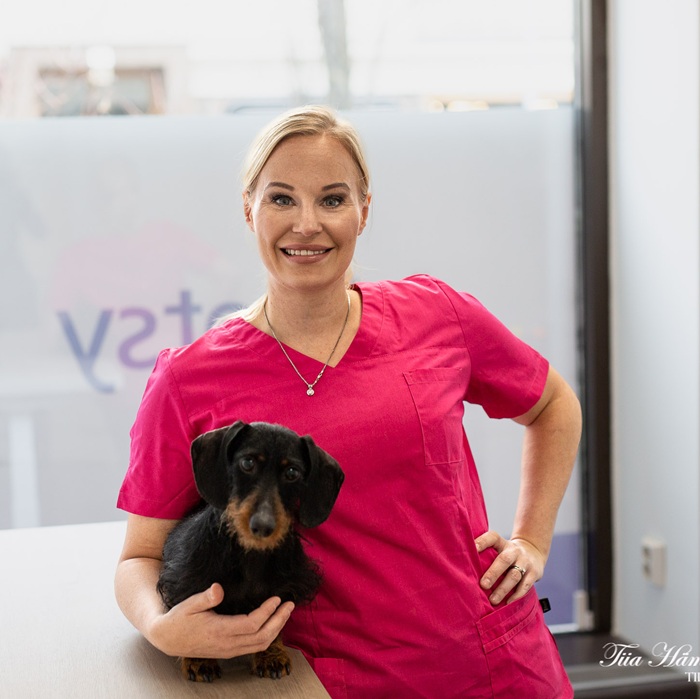
I have worked almost my entire career, since 2008, as a small animal veterinarian. Clinical work with dogs, cats, and their owners is still my passion. Clinical nutrition has accompanied me as an area of interest already since the beginning of my studies. I have developed my expertise purposefully through international continuing education, by familiarizing myself with scientific literature, and through practical clinical work.
In clinical practice, I repeatedly observed that in the treatment of many diseases, the importance of feeding received little attention, even though nutrition can often significantly affect the animal’s symptoms, quality of life, and prognosis. This observation led me to deepen my expertise in clinical nutrition.
Continuing education in nutrition for veterinarians
After my basic degree, I have supplemented my expertise with several nutrition trainings intended for veterinarians.
All of my main trainers in nutrition are European specialist veterinarians in clinical nutrition (Diplomates of Veterinary Nutrition), which represents the highest international level of nutritional expertise among veterinarians.
I have completed the Austrian Veterinary Chamber’s diploma training in nutritional counseling for small animals (Österreichische Tierärztekammer Diplom Ernährungsberatung Kleintier), which is a two-year continuing education program intended exclusively for veterinarians.
Maintaining the diploma is not a one-time achievement. The Austrian Veterinary Chamber requires continuous continuing education and maintenance of competence from diploma holders. As a member of the Austrian Veterinary Chamber, I must also regularly be able to verify my participation in further training in the field in order to maintain the validity of the diploma.
The responsible trainers of the diploma program are:
- Dr. Irene Bruckner, specialist veterinarian in nutrition
- Dr. Steffi Handl, Diplomate ECVCN
Both are internationally recognized experts in clinical nutrition and also act as trainers in the ESAVS nutrition education programs.
Other continuing education in nutrition
I have participated in several clinical nutrition trainings intended for veterinarians, including:
Rationsberechnung in der Tierarztpraxis
– Part 1
– Part 2
Magen, Darm & Pankreas – Gastroenterologie & Diätetik im Fokus
Trainer: Dr. Julia Fritz
- Diplomate ECVCN
- Fachtierärztin für Tierernährung und Diätetik
- Zusatzbezeichnung Ernährungsberatung Kleintiere
Dr. Fritz is among Europe’s highest-level nutrition experts in the field of veterinary medicine.
Current continuing education
I am currently completing a one-year, 60-hour continuing education program in nutrition intended exclusively for veterinarians:
Vet Clinical Nutrition Academy (VCNA)
The trainers are:
- Dr Moran Tal-Gavriel, BSc, DVM, DVSc, Dip ECVCN
- Dr. med. vet. Kerstin Gerstner, DVM, Dip ECVCN
- Dr Cecilia Villaverde Haro, BVSc, PhD, Dipl. ACVIM, ECVCN
Practical work in the field of nutrition
Clinical nutrition is not only education for me, but also a long-term practical area of interest.
In 2023, I started developing my own computer software for planning individualized diets for dogs and cats.
The goal was to build a system that enables:
- the planning of individualized diets
- milligram-precise nutrient calculation
- balancing home-prepared diets and raw feeding
- planning nutritional treatment for diseases
utilization of different international - nutritional guidelines in practical work
The development of the project has required hundreds of hours of familiarizing myself with literature, studying nutritional science, and building the information system.
Current international standards, such as:
- National Research Council (NRC)
- FEDIAF
- AAFCO
provide only a limited number of disease-specific nutritional reference values.
For this reason, I have built into the software a broader reference value system based on:
- scientific literature
- international guidelines in the field
- knowledge acquired through continuing education
- clinical experience
The goal is to enable as precise and evidence-based nutritional support as possible also in situations where ready-made commercial diets are not available or are not suitable for the particular patient.
View of clinical nutrition
I consider nutrition to be one of the most underutilized forms of treatment in veterinary medicine.
A properly planned diet can:
- prevent diseases
- support medical treatments
- reduce symptoms
- improve quality of life
- and in some diseases constitute a significant part of the actual treatment.
I consider it particularly important that nutritional recommendations are based on scientific evidence, the individual situation of the animal, and solutions that are feasible in practice.

At PetDietPlans, we are pioneers in nutrition
Eva Kaisti
Certified Veterinary Nutritionist,
Founder of PetDietPlans