
Assessing a dog’s weight is not merely a matter of appearance. It is a health indicator that reflects overall wellbeing, physical performance, and quality of life. Excess weight places strain on the body and increases the risk of several diseases. A dog’s weight cannot be reliably evaluated by the number on the scale alone, as breed size, body structure, and muscle mass all influence that figure. The most accurate method for assessing a dog’s body condition is the Body Condition Score (BCS) system.
What is body condition score (BCS)?
Body Condition Score is a visual and hands-on assessment method used to estimate a dog’s body fat in relation to muscle and skeletal structure. The evaluation involves observing the dog from different angles and palpating specific anatomical points, such as the ribs, spine, and pelvic area.
The BCS scale may range from 1–5 or 1–9. The 1–9 scale is more commonly used because it allows for more precise differentiation between body conditions. A dog with a BCS of 4–5 out of 9 is considered to be at an ideal body condition.
How to assess your dog’s body condition?
The evaluation consists of three components: palpation, top view assessment, and side profile assessment.
Palpation
Feel your dog’s ribs. They should be easily palpable without excessive pressure, but they do not need to be visibly protruding. If locating the ribs requires firm pressure or if they are covered by a thick fat layer, the dog is likely overweight.
Top view assessment
Observe your dog from above. A dog at a healthy weight should have a visible waistline behind the ribs. If the waist is absent and the back appears broad and flat, this suggests excess body fat.
Side profile assessment
Viewed from the side, the abdomen should tuck upward from the ribcage toward the hind legs. A straight or sagging abdominal line is a sign of excess weight.
What different BCS scores indicate?
The BCS scale allows for accurate classification of body condition. In simplified terms:
- Underweight: Bony prominences are clearly visible and easily felt.
- Ideal weight: Ribs are easily felt, and a distinct waistline is visible.
- Overweight: Fat covers the ribs, and the waistline is not clearly defined.
- Obese: Significant fat deposits are present; ribs are difficult to feel; the abdomen appears rounded with minimal or no abdominal tuck.
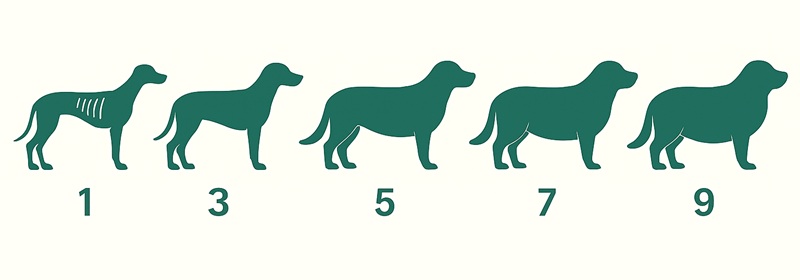
1 Life-threateningly underweight (image 1)
- Ribs, lumbar vertebrae, and pelvic bones easily visible
- No palpable fat
- Some bony prominences visible from a distance
- Minimal loss of muscle mass
2 Severely underweight
- Ribs easily palpable and may be visible with no palpable fat
- Tops of lumbar vertebrae visible, pelvic bones becoming prominent
- Obvious waist and abdominal tuck
3 Underweight (image 3)
- Ribs easily palpable with minimal fat covering
- Waist easily noted when viewed from above
- Abdominal tuck evident
4 Ideal to slightly underweight
- Ribs palpable without excess fat covering
- Waist observed behind ribs when viewed from above
- Abdomen tucked up when viewed from side
5 Ideal weight (image 5)
- Ribs palpable with slight excess of fat covering
- Waist is discernible when viewed from above but is not prominent
- Abdominal tuck apparent
6 Slightly overweight
- Ribs palpable with difficulty, heavy fat cover
- Noticeable fat deposits over lumbar area and base of tail
- Waist absent or barely visible
- Abdominal tuck may be absent
7 Overweight (image 7)
- Ribs not palpable under very heavy fat cover or palpable only with significant pressure
- Heavy fat deposits over lumbar area and base of tail
- Waist absent
- No abdominal tuck
- Obvious abdominal distension may be present
8 Obese
- Massive fat deposits over thorax, spine, and base of tail
- Waist and abdominal tuck absent
- Fat deposits on neck and limbs
- Obvious abdominal distension
9 – Life-threatening obesity (image 9)
- Ribs are not palpable even with significant pressure; thick fat deposits cover the chest, back, and base of the tail.
- Waist is completely absent, abdominal tuck is missing, and the abdomen may be sagging or clearly distended.
- Fat deposits are also visible on the neck and possibly on the limbs; normal body shape is completely obscured.
- Movement is difficult, panting occurs easily, and health risks are significantly increased.
Why excess weight matters?
Excess weight is not simply a cosmetic concern. It significantly increases the risk of health problems and places chronic strain on the body. Overweight dogs are more prone to joint disorders, respiratory issues, cardiovascular strain, and metabolic diseases. In addition, excess weight can reduce activity levels and negatively impact overall quality of life.
Ensuring an accurate assessment
BCS evaluation should be performed in a calm setting and repeated regularly, for example once a month. Weight gain may not be immediately obvious visually, but consistent BCS assessments help identify gradual changes early. Consultation with a veterinarian is advisable if there is uncertainty about the assessment or if weight gain occurs without an obvious cause.
Conclusion
Canine obesity is not an aesthetic issue; it is a direct indicator of health status and wellbeing. By using the Body Condition Score system, you can assess your dog’s body condition more reliably than by relying on scale weight alone. Evaluating rib palpation, waist visibility, and abdominal profile provides a clear picture of whether your dog’s weight is appropriate. When weight is properly managed, dogs move more comfortably, maintain better stamina, and are more likely to live longer, healthier lives.